Into the Mortal Realms: A Conversation With Erik Ney, Creator of Mortal Existence

Some games are played. Others are endured, remembered, and carried forward.
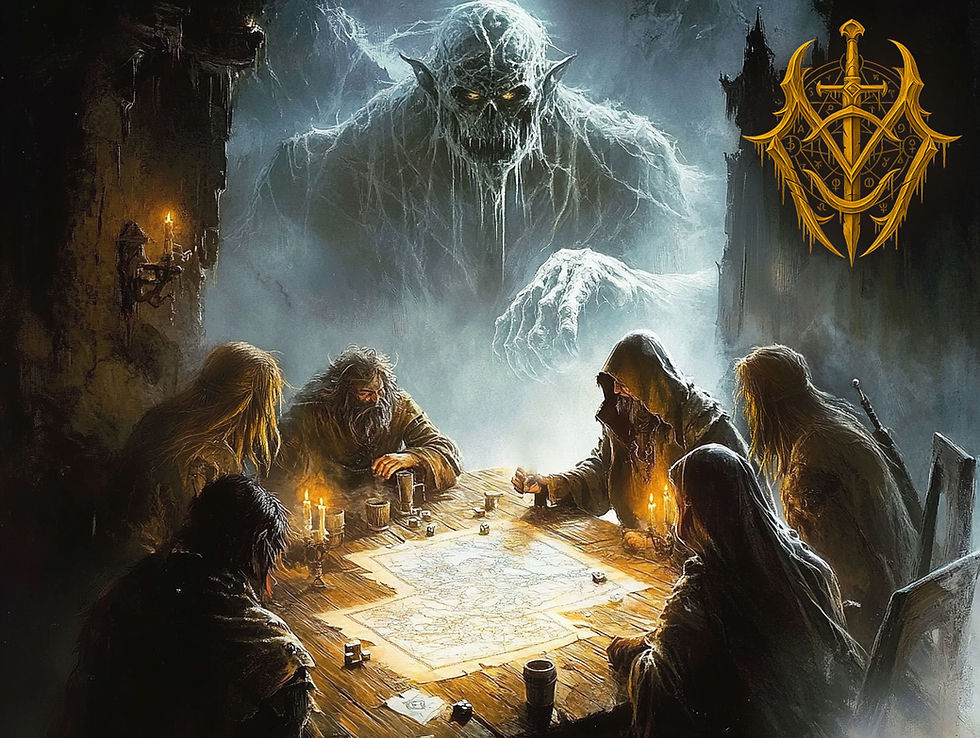
Mortal Existence is the result of a lifetime spent thinking about worlds—how they breathe, how they punish, and how they reward those who pay attention. Developed over the course of more than four decades, it is a tabletop role-playing game rooted in classic fantasy, sharpened by consequence, and driven by immersion rather than convenience.
At the center of it all is Erik Ney, the creator of the Mortal Realms. Drawing inspiration from early fantasy literature, formative tabletop experiences, and a deep respect for narrative weight, Erik has built a game where survival is never assumed, morality is fluid, and characters are shaped as much by loss as by victory.
In this first official blog post for the Mortal Existence website, Erik shares the origins of the game, the philosophy behind its design, and what he hopes players experience when they step into the Mortal Realms.
What initially sparked the idea for Mortal Existence?
Reading Tolkien's The Hobbit and playing Dungeons and Dragons when I was 12 - 13 years old.
What emotional or philosophical experience do you want players to have?
I want the players of Mortal Existence to escape to a Realm that is deep, immersive, exciting and endless. I want the players to become invested in their characters. The different character races and guilds are complex and profound, and it is easy to get attached emotionally to these characters, and to intellectually inhabit them.
Through shared adventures with other players, encountering difficult situations (much like real life), working together to achieve shared goals and gain in power and abilities, it is easy to go as deep as you want into the Mortal Realms and your characters. It's nice to get lost in The Mortal Realms and escape from reality for a while.
What are the core themes of Mortal Existence?
To survive in the perilous Mortal Realms, it is important to have diversity of character guilds and to work together as a team with other characters (players) in order to survive. If a character dies in the Mortal Realms, that character cannot come back (unless resurrected by magic).
Players have the option to play a number of different Moral Dispositions from pure good, to non-aligned-with-good-tendencies, to non-aligned, to non-aligned-with-evil-tendencies, to pure evil. Characters will align themselves to these Moral Dispositions as they wander through The Realms. This adds an air of realism, just as there are good and bad people in real life.
Anticipation of the unknown plays an exciting role in Mortal Existence. There are a number of Adventures that will take the characters on unique and exhilarating journeys throughout the Mortal Realms. Additionally, just wandering the perilous Realms can prove to be exciting, as encounters with monsters and creatures are always imminent. Planning and making the right choices are integral to survival. However, sometimes it comes down to the luck of the dice.
There's a time to know when to run, and a time to stand your ground and fight. It's important to review your characters strengths, weaknesses, abilities, magic and items and weapons, so you are prepared for any situation. You need to maximize your chances for survival, because it is a precarious survival in The Mortal Realms.
What influences shaped the world and tone of Mortal Existence?
Tolkien has always been my greatest influence. He was a brilliant man with perhaps the most amazingly creative mind in history. The worlds, history, languages, and depth of characters that he developed was unmatched (but I will try with Mortal Existence).
The Hobbit and The Lord of the Rings (books and movies) have had great influence on Mortal Existence. There have been a number of other movies (like Legend, which was creatively whimsical, and The Sword and the Sorcerer and Conan the Barbarian, among others) and shows like Vikings and Game of Thrones that have also provided influence.
Authors like Dennis McKiernan, whose books are deep and exciting, have also added some influence through the years. A few video games, such as Skyrim, and computer games, like Zork, have also sparked some ideas. And of course, the TTRPGs that I played in the past, like D&D, Gamma World and even Top Secret, have provided some vision for Mortal Existence. I have been told, that building on the ideas and creativity of others is how all good new creations come into existence.
What distinguishes the spirit or approach of Mortal Existence from other tabletop RPGs?
The depth of characters and the immersive world with endless possibilities helps to distinguish Mortal Existence among role playing games. It is part adventure, part horror and part whimsical. The rules are grounded, but grounded in a fantastical world of magic, mystery, uncertainty and intrigue.
Talking to my friends and consultants, who have played a number of other TTRPGs, Mortal Existence is "An Evolution in Classic Role Playing Games."
Other players stated:
"You have a great system." Personally, I'm not sure what that means, since I haven't played any TTRPS other than Mortal Existence for decades. Not because I don't think I would enjoy them, but because I didn't want them to influence Mortal Existence."
"You need to put a lot more thought and strategy into Mortal to keep your characters alive. He also mentioned that there is a lack of renewable magic. Magic requires conduits, and comes at a price."
"The numbers that are rolled up during Character Generation dictate what you can be. You can't just choose. It makes you play character types that you might not normally elect to play. And you learn to love these characters."
"The Characters are so in depth."
"Mortal Existence feels more real than just fantasy."
"You have to maintain your weapons and armor."
"Nothing is implied. You have to be specific."
"This world wants to kill you! You need to work together to succeed."
There is a great and profound history to the Mortal Realms that is still being developed.
Players of Mortal Existence say that they can recite exactly what happened each gaming session, going back months or years!
About the Creator of Mortal Existence
Erik Ney lives in Lancaster, PA with his wife Sherri. He is a musician/bassist who helped found the bands Sacrament and Fountain of Tears. Erik has been developing fantasy role playing games for many years, and specifically the TTRPG Mortal Existence for over 40 years. Mortal Existence is his passion, and he looks forward to further developing the game as the years go on.
Mortal Existence is not a game built for shortcuts or spectacle alone. It is a world shaped by time, patience, and intention; one that rewards attention, cooperation, and memory. As the Mortal Realms continue to expand, so too will the stories forged within them, written not by a single hand, but by every player willing to risk something real at the table. This is only the beginning...


Comments